
December 2025
DECEMBER 16 PRESENTATION AT BRUSSELS CENTER FOR JOURNALISM STUDIES, KU LEUVEN, BRUSSELS, BELGIUM
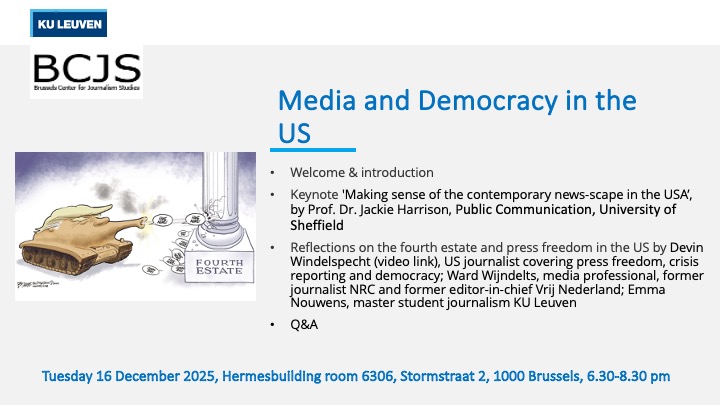
In December 2025, the UNESCO Chair delivered the keynote speech at the Brussels Center for Journalism Studies at KU Leuven. The talk was titled: ‘Making sense of the contemporary news-scape in the USA’. The UNESCO Chair spoke about how the numbers of countries across the world are becoming autocratic, focusing specifically on the United States. She spoke about a decline of freedom of speech and the harassment of journalists, but highlighted how the news media can and does exercise resistance to ‘democratic backsliding’.
To how understand how these contradictory forces of state power and an independent news media play out she argued that we need to understand how the American news-scape is comprehensively configured. Most descriptions try to formulate the American news-scape in terms of one (or a combination of) of three basic dimensions: convergence between old and new news media, commercial interests and the exercise of state power. The UNESCO Chair’s argument is that one way to better understand news-scape is to organise these three dimensions around two particular comparative communicative civil and political ideas: 1) the news which exists in an agonistic environment and retains a pluralistic outlook and 2) the news which resides in an antagonistic news environment and has a partisan outlook. So far evidence shows that an increasingly defining feature of the American news-scape is toward partisan news and the declining influence of the ‘traditional news media’. But is this entirely accurate? Unlike repressive or authoritarian news-scapes the US experience is one where criticism of excessive use of state power is extant, that reprisals against news journalism are consistently publicised and condemned and where the outcome between the pluralists and the partisans is not yet settled.
OCTOBER 2025
October 22-24 Presentation at Civil Sphere Working Group Meeting, Vienna, Austria
In October 2025, the UNESCO Chair on Media Freedom, Journalism Safety and the issue of Impunity participated in the Civil Sphere Theory Working Group meeting at the University of Vienna. She presented a research paper titled: State Power and The Civil Power of The News: A Power Matrix. This work builds on and develops her work on the Civil Power of the News and her work on media freedom as the UNESCO Chair.
In the presentation, she discussed how the exercise of state power toward news journalism seeks to bring particular types of communicative conditions under which news journalism is forced to operate in constant tension with state power and she is currently writing a book on this area of her research.
May 2025
May 2-5 World Press Freedom Day, Brussels, Belgium
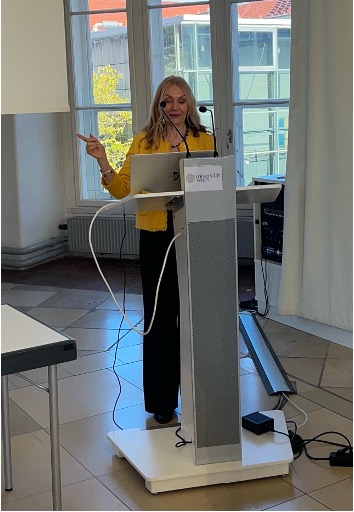
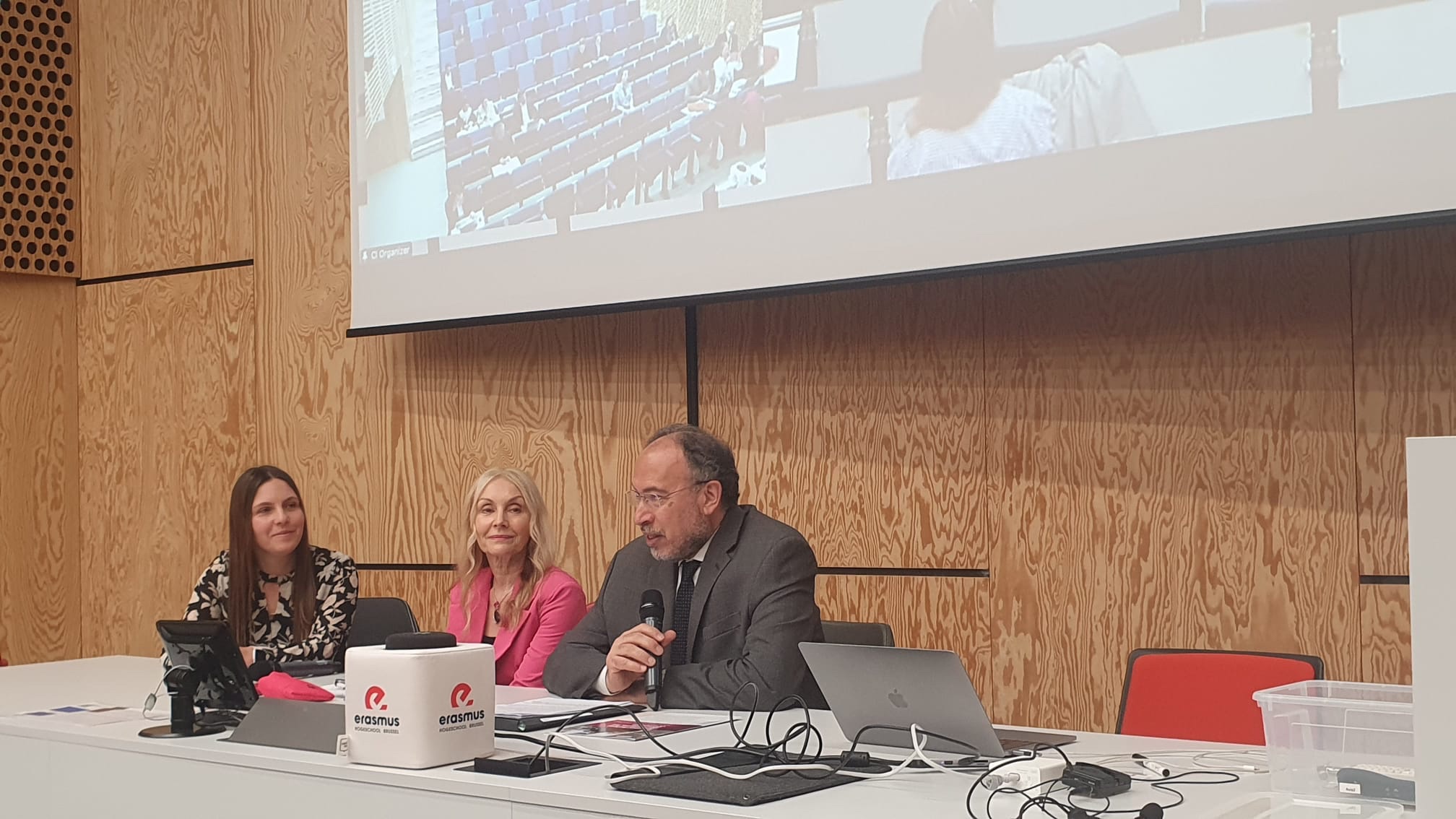
CFOM Researchers travelled to Brussels, Belgium, to take part in the Academic Conference as part of World Press Freedom Day. The UNESCO Chair delivered opening remarks as part of the conference alongside Dr. Tawfik Jelassi (right), Assistant Director-General for Communication and Information, UNESCO and Dr. Vera Slavtcheva-Petkova (left), Associate Dean Global Engagement, University of Liverpool.
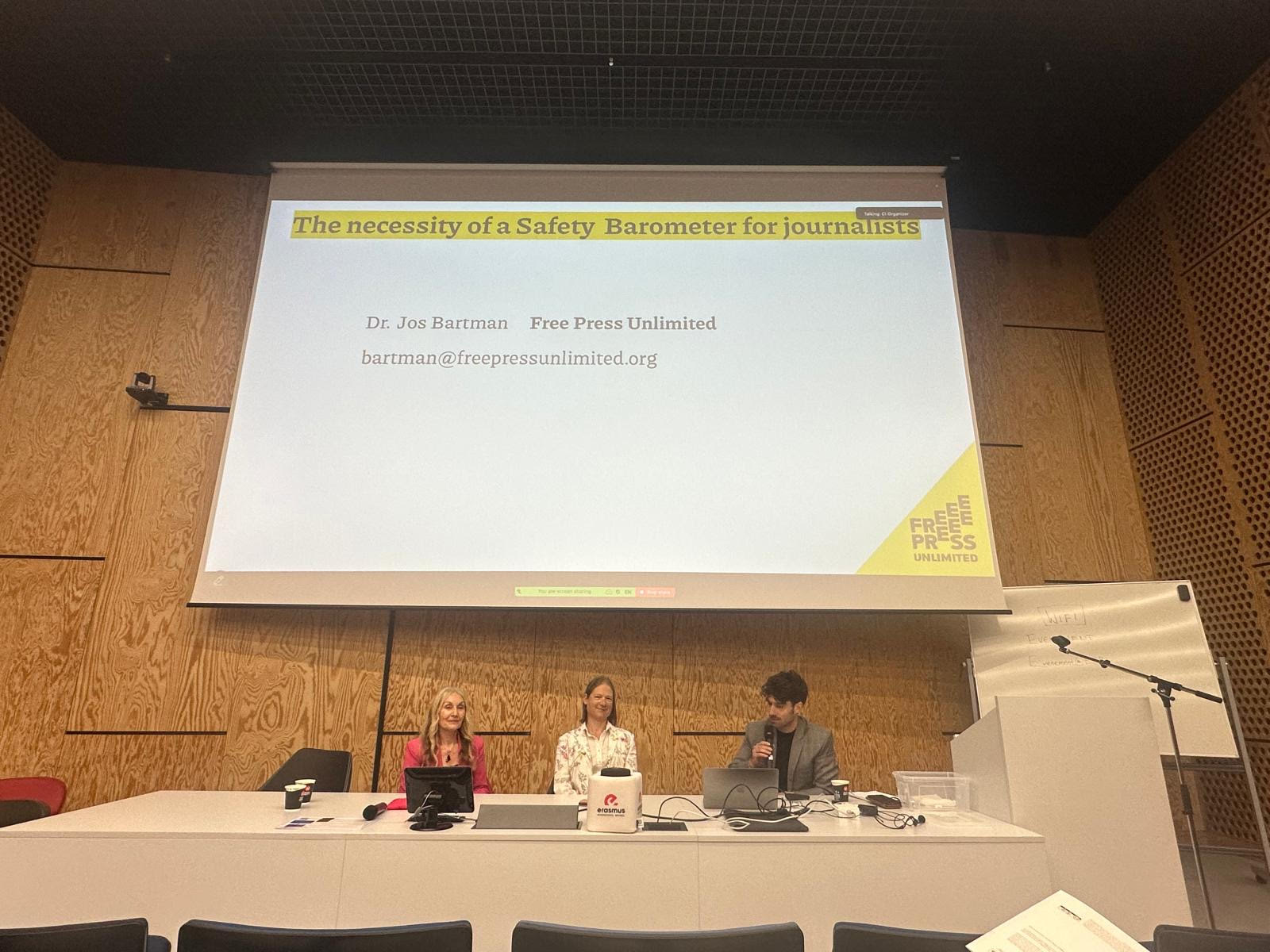
The UNESCO Chair and CFOM Researcher, Dr Diana Maynard, along with Free Press Unlimited’s Jos Bartman, hosted a panel as part of the conference. The panel spoke about their project focusing on monitoring. The project aims to improve the understanding of the contextual predictors of lethal and non-lethal violence towards journalists.
As things currently stand, adequate monitoring of attacks against journalists is currently lacking, especially in line with UN SDG 16.10.1, which specifies the categories of killing, kidnapping, enforced disappearance, arbitrary detention, torture and “other harmful acts”.The UNESCO Chair spoke specifically about how different communicative contexts in which journalists operate across the world and are decisive in understanding that attacks on journalists don’t emerge out of thin air. She provided a new typology of four different scenarios in order to better understand and assess the communicative conditions in which journalists are expected to operate.